

I probably don’t need to expound on the patchwork policy-driven crisis universities are facing with international student populations: if you work in higher ed, you’re already knee-deep in the struggle to recoup the academic and economic enrichment lost by the steepest international enrollment drop on record. And from the looks of it, the 2027 semesters are going to drag institutions down even deeper.
What I will call out, as both a professor and conversational AI startup founder, is that many universities trying to address this student shortage are making one of the same fundamental mistakes that high-growth companies make: focusing on volume at the expense of efficiency. In a fully digital academic world (which international students experience even more acutely than domestic students), admissions yield is the hurdle that all your best recruiting efforts have to clear.
It’s not to say universities shouldn’t be recruiting more aggressively and creatively than ever: rather, that increased international recruiting efforts across an entire sector will naturally surface the problem of each university needing to be more thoughtful in how it differentiates itself, and how it caters to increasingly foreign cultures and expectations.
Policy Is The Hill, But The Boulder Need Not Be So Big
I don’t think this gets said enough: a prospective international student deciding between the U.S., the UK, Canada, Australia, or an increasingly competitive set of destinations elsewhere in Europe or Asia isn't just weighing visa risk. They're weighing it at 2am their time, in a second language, possibly without anyone else in the family to provide guidance… and doing so against a university website that was built for a domestic applicant who already knows the bevy of academic acronyms, what a bursar's office does, and that "rolling admissions" isn't a threat.
Every one of those moments of friction is a moment a competing institution, or a competing country, picks up the applicant an American university just lost. And unlike visa policy, this part is entirely within a university's control. It doesn't require an act of Congress. It requires treating the digital experience of a prospective international student with the same dignity and attention the sector already applies to recruitment travel budgets and glossy brochures translated into three languages, when the actual decision-making now happens on a website, at all hours, in dozens of languages a translated PDF was never going to cover.
The Ambassador Problem
Universities already know they need a human presence in the countries they recruit from: regional reps, agents, alumni networks. What very few of them have is a digital equivalent: someone who can meet an applicant from Lagos, Mumbai, or São Paulo on the institution's own website, in that applicant's own language, and answer the specific, anxious, procedural questions that determine whether they finish an application or abandon it: What are current international students saying about the campus environment? What does this visa policy change actually mean for me? Is my program still accepting applications? What happens if my SEVIS record gets flagged?
This is precisely the gap I built skilly to close. A skilly guide can act as that international ambassador on a university's own digital doorstep, holding 24/7 conversations in more than 400 languages, drawing only from an institution's own governed, private data layer so answers stay accurate and current as policies shift, and escalating to a human recruiter or international student office the moment a question needs that level of attention. It isn't a replacement for the regional reps and international student advisors who do this work today; it's the custom-crafted safety net that ensures the thousands of applicants those teams will never have the bandwidth to reach 1:1 still get answers that are clear, current, and in a language they actually trust.
Tactical Guidance On Admissions Yield
The institutions that will weather these upcoming enrollment cycles aren't the ones hoping visa policy reverses. They're the schools asking a narrower, more answerable question: amidst everything currently outside our control, where can we still differentiate on our own terms? For a lot of universities, the honest answer is sitting in their own admissions funnel data: how many international applicants start a form and never finish it, how many inquiries in a non-English language go unanswered for days, and how many prospective students never even find the page that would have answered their question.
That's a fixable problem at a tactical level. It just requires treating a university's digital front door with the same care it treats the physical one. To that end, here’s part of the playbook we built alongside our higher ed clients to bridge international interest to application and maximize admissions yield:
Answer Engine Optimization (AEO):
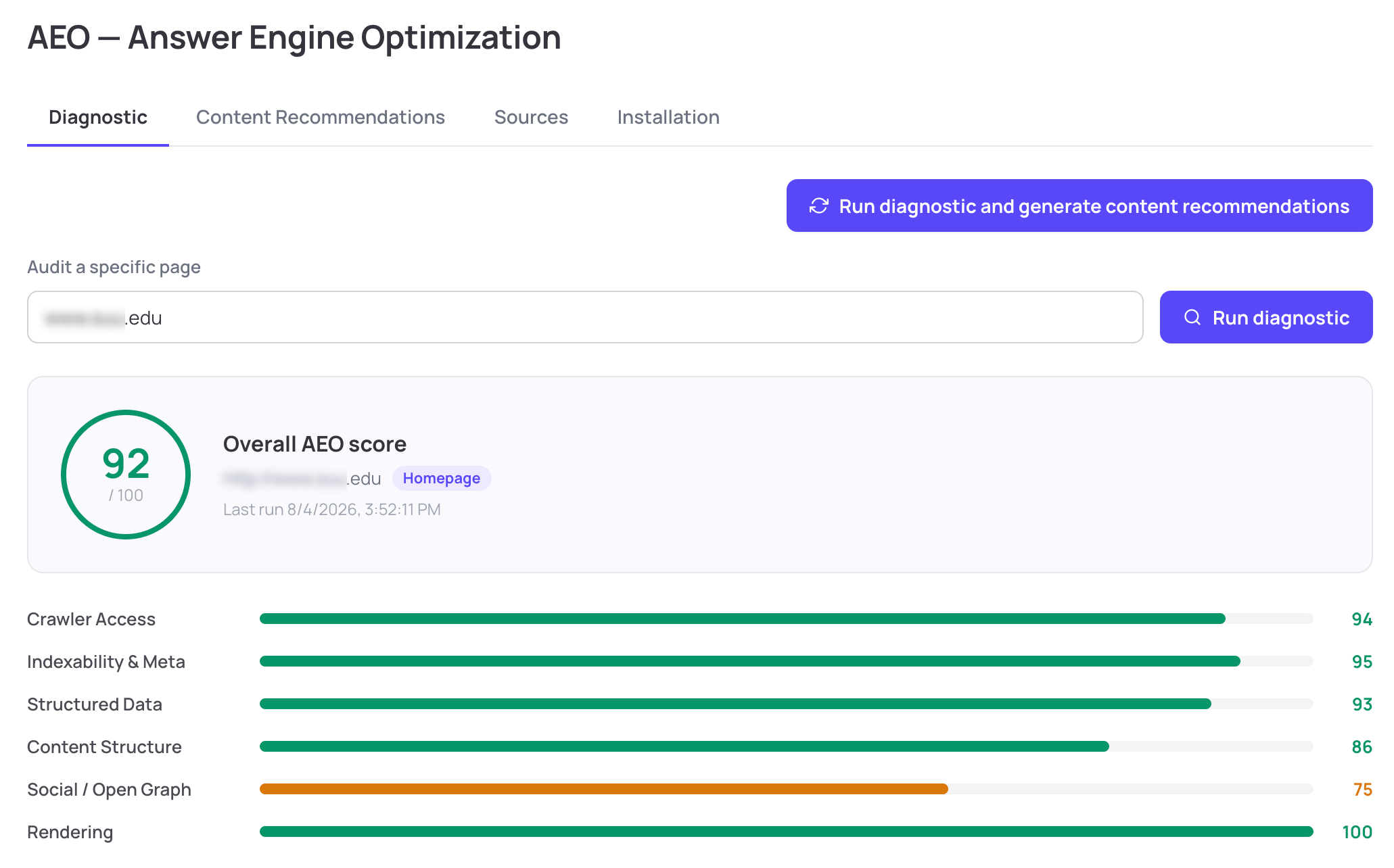
Every prospective student (international or otherwise) is going to research your school on ChatGPT or Claude before, and during, their visit to your own website. What does that have to do with you? The frontier LLMs don’t inherently present favorable information on your school, or know how to find impactful, up-to-date answers: they rely on whatever the web presents them, and the most optimized websites have outsized influence on how your school is presented. That’s why skilly has a built-in AEO monitoring tool with step-by-step optimization guidance, along with automatically generating LLM-favored documents that you can upload to your site knowing those docs will auto-update as your knowledge base grows. AEO typically carries a multi-thousand dollar monthly bill from an outside agency… skilly provides it as a free feature.
Student Testimonials:
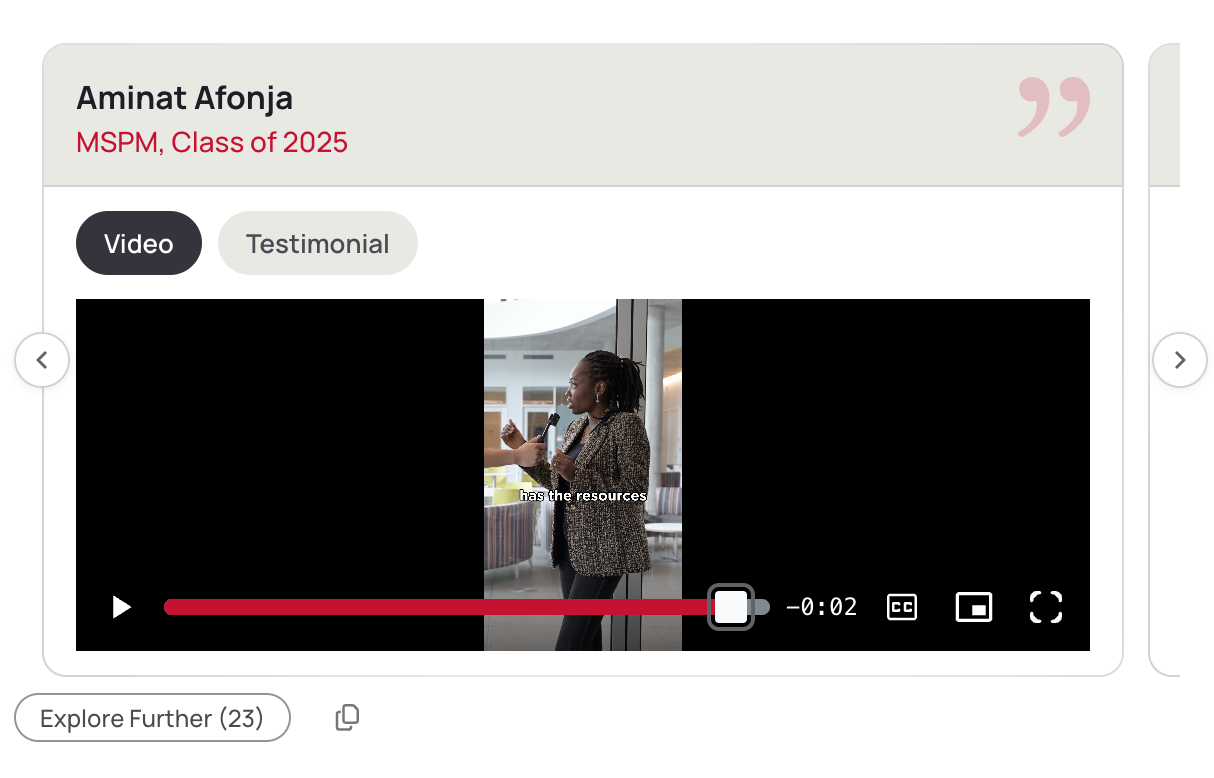
No polished brochure or reputable faculty member can make as honest an impression as a fellow international student. Putting those testimonials front and center on your digital doorstep is crucial, and the same goes for presenting them organically in conversation. Skilly will actively seek to share this multimedia content when any student appears to be asking for insights on the university’s culture or the international student experience. We even have a built-in testimonial generation tool to help you create the content with less legwork. It’s empathetic engagement that, ironically, requires the speed of AI to surface fast enough that the conversation can flow at human pace.
Multilingual Content:
Any university with a significant international draw is likely spending upwards of $1,000 per applicant to ensure the culture of the campus and programs is properly represented in multiple major languages. Skilly does this for any materials or messaging you have, regardless of whether it’s been previously translated… and does so in 400 languages. It begs the question: as universities combat policy hurdles by expanding their international reach, how many prospective students don’t see themselves represented on the website? With skilly, you’ll find out in just a few weeks.
24/7 Availability:
Layer some international timezones on top of the typically odd hours that prospective students keep, and you’ll find higher ed is among the riskiest sectors for relying on a 9–5 staff to handle inbound questions 24/7/365. Tasking skilly to act as your conversational safety net is a no-brainer here, as it is uniquely governed and guided by your own knowledge base to operate just like a fellow team member; a team member who just happens to be a subject matter expert that doesn’t sleep, and always guides users towards your goals.